Most nonprofit AI experiments stall before they reach production, and the cause is rarely the model. The real blockers are trust, orchestration, and governance.
A pilot that drafts a donor email or summarizes a case note is easy to demo. Letting AI act inside your live program, donor, and compliance workflows is a different bar. This post covers why pilots stall, what Agentforce changes, and what your Salesforce foundation needs so AI can be trusted with real work.
Why nonprofit AI pilots stall
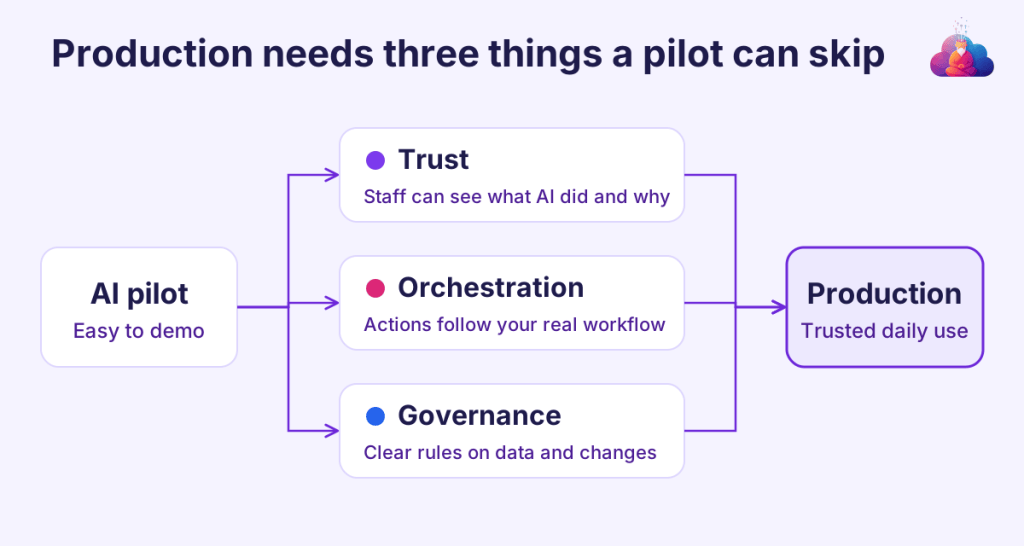
Pilots usually fail at the handoff from experiment to everyday operations, for three reasons:
- Trust. Staff and leadership will not rely on AI that cannot explain what it did or why, especially when donors and program participants are affected.
- Orchestration. A useful AI action rarely lives in one system. It has to follow your real workflow, from intake to approval to follow-up, in the right order.
- Governance. Someone has to own the rules: who can see which data, what the AI may change, and how every action is recorded.
General models don’t know your rules
General foundation models are highly capable, but they do not know your program eligibility rules, your donor data permissions, or your compliance requirements. Left on their own, they produce confident answers that may not respect any of those boundaries.
For a nonprofit, that gap is where the risk sits. A grant report, a donor communication, or an eligibility decision has to be right and has to follow your policies, not just sound plausible.
How Agentforce closes the gap
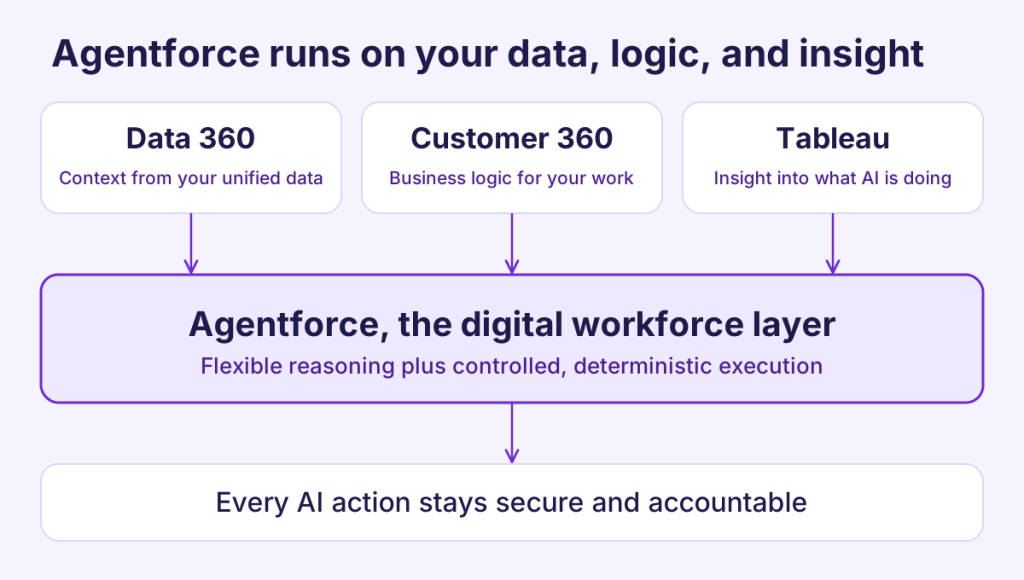
Agentforce, Salesforce’s digital workforce layer, combines flexible reasoning with controlled, deterministic execution inside your existing workflows. The AI can interpret a request, while the steps that matter run by rules you define.
It draws on three parts of the Salesforce platform:
- Data 360 provides the context, so the AI works from your unified data.
- Customer 360 provides the business logic that reflects how your organization operates.
- Tableau provides the insight, so leaders can see what the AI is doing and what it is producing.
Together, they keep every AI action secure and accountable.
Production-ready AI starts with the foundation
AI can only be as trustworthy as the system underneath it. Clean data, clear processes, and defined access come first. Our recent nonprofit projects show what that foundation looks like in practice:
- Graduate Philadelphia moved from a fragmented legacy org to a clean Nonprofit Cloud implementation, with a structured data model, status-driven workflows, and reporting for leadership and board communication.
- East Buffalo Development Corporation now runs its Vacant Rental Program on a structured model with role-based access, eligibility screening, and UAT governance for internal adoption.
- Small Things Enterprises has a loan program design with defined accounting safeguards and audit-ready tracking, built so the team can scale without over-investing upfront.
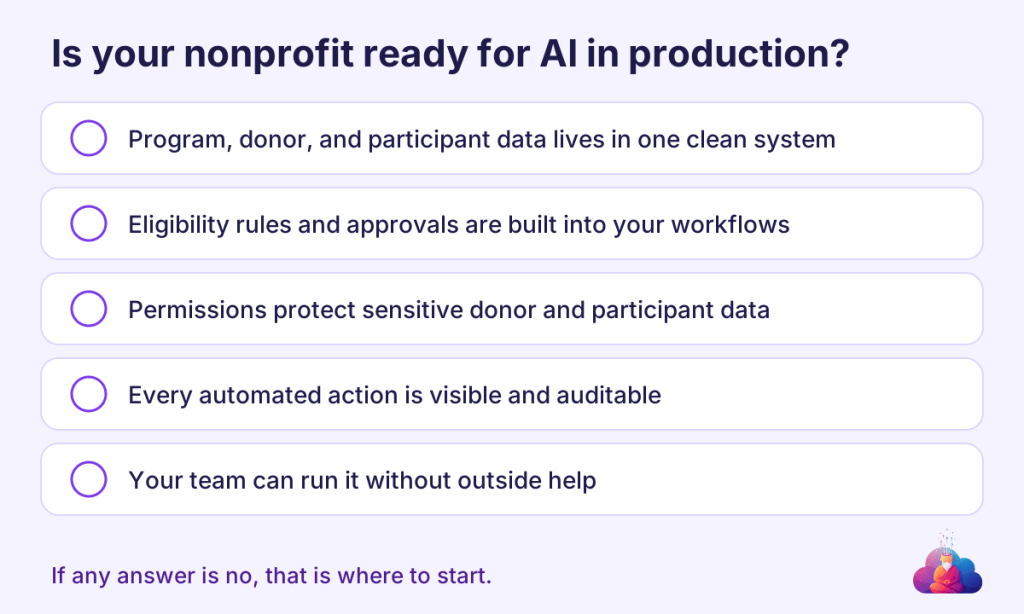
The pattern is the same each time: a data model your team understands, workflows with clear statuses, role-based access, and training and documentation so people can run it themselves. That is the ground AI needs to act safely.
How CloudSage helps
CloudSage Consultancy Inc. helps nonprofits bridge the gap between AI pilot and production. We are strategic architects, not just software installers, and we give small nonprofits senior-level Salesforce expertise without the enterprise overhead.
We design CRM systems your team can actually run, then keep them improving through automation and practical AI. The goal is to turn raw intelligence into trusted, production-ready execution on your timeline.
Is your nonprofit ready for AI in production?


Leave a Reply